Ring-necked Duck
Aythya collaris
Alternate names: Ringneck, Ringbill, Blackjack
- Length
- 15-18 in
- Weight
- 1.1-2.0 lb
- Wingspan
- 24-25 in
- Range
- Mississippi Flyway first, then Atlantic and Central, with a Pacific group in California
Overview
The Ring-necked Duck is the diver of small water. It uses shallow ponds, impoundments and marsh pockets with cattail and wild rice that Canvasbacks, Redheads and scaup pass up. The Mississippi Flyway takes the most birds, with Louisiana impoundments and Florida lakes among the main wintering areas. The neck ring that gives the species its name is almost never visible in the field, so go by the bill.
- Continental population is near 2 million, and US hunters take roughly 390,000 a year
- Historically swallowed lead shot at some of the highest rates of any waterfowl
- Numbers rose in the 1980s and early 1990s while most prairie-nesting ducks declined
How to ID It
- Peaked rear crown and an angular head profile
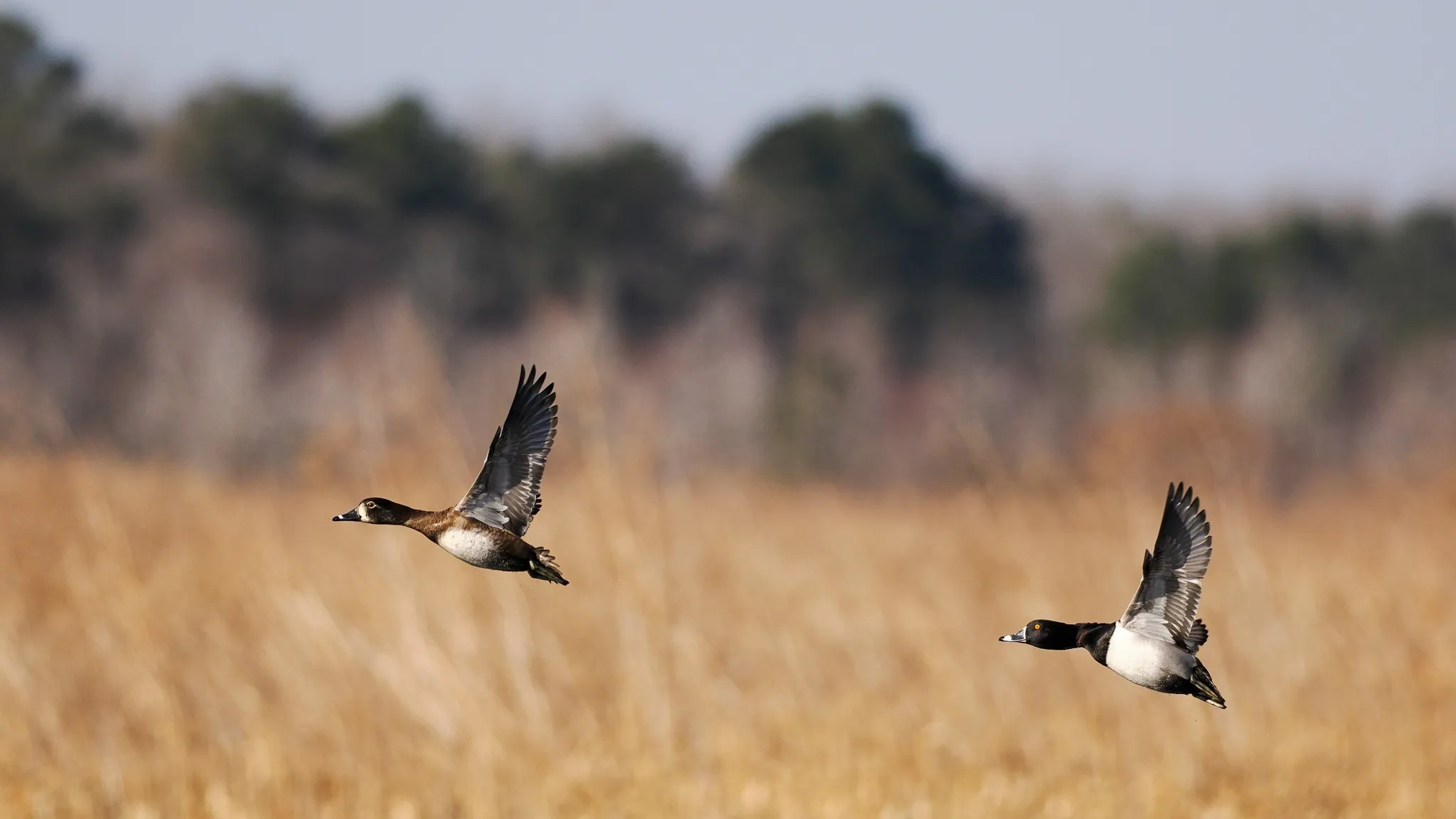
- Drake: Black back and chest, with a white wedge between the breast and gray flank
- Drake: Slate bill with a bold white band near the black tip
- Drake: Black head with a violet sheen and a yellow eye
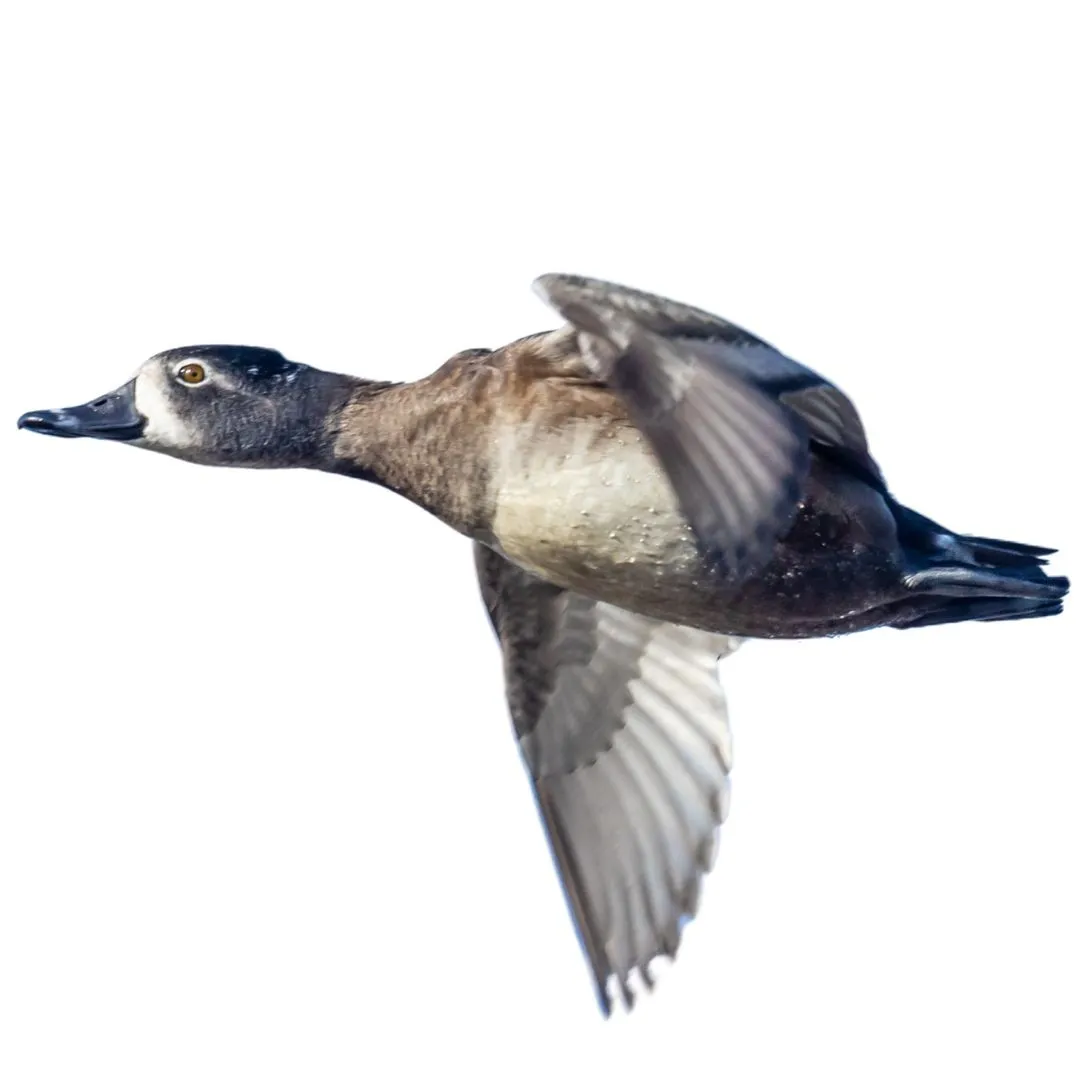
- Hen: Brown with a white eye-ring and a thin white line that runs back from the eye
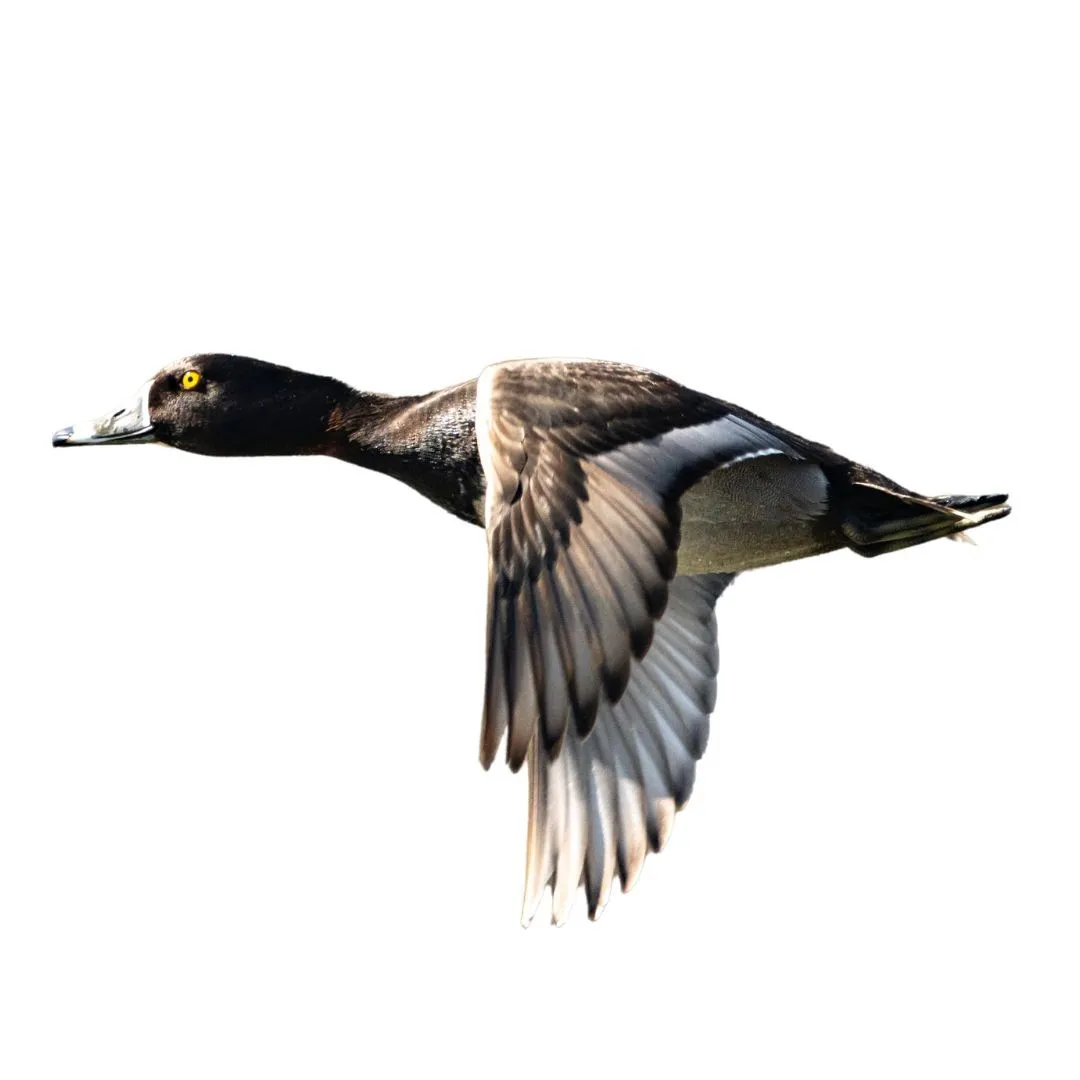
- In flight: Dark wings with a gray speculum and no white wing stripe
Identification
Ring-necked Ducks are compact divers, about the size of a Lesser Scaup and smaller than a Mallard. They swim buoyantly for a diver and ride higher on the water than other divers do. On the wing the silhouette is a large head on a thin neck over a short, round body, flown with fast, choppy wingbeats. At range scaup look much the same until they fly, and a ringneck's wings show no white stripe.
Head
The peaked rear crown is the shape to trust on the water.
A short crest at the back of the crown makes the profile angular, and the crown flattens when the bird dives. The drake's head is black with a violet sheen. The hen's is brown, darkest on the crown. A Lesser Scaup shows only a small peak, and a Greater's head is smoothly rounded.
Bill
The white band near the bill tip is the mark to look for.
The drake's bill is slate or bluish gray, with a narrow white edge at the base and a broad white band before the black tip. The hen's is slate with a faint pale band. Scaup bills are plain pale blue-gray, so a white band on a diver's bill means a Ring-necked Duck.
Wing
Dark wings stand out against the white-edged wings of scaup.
From above, the drake is black-backed with uniformly dark wings, and the gray speculum is the only pale patch. The hen is drab brown with a brown-gray upperwing. Underwing coverts are variably gray with white axillars. Scaup show a white wing stripe, so dark wings pick out a Ring-necked Duck in a mixed flock.
Body
A compact, buoyant diver with pale sides and a white belly.
The body is compact and rides buoyantly, with a white belly. The drake's flanks are pale gray to white with fine vermiculation and the undertail coverts are black. The hen has warm brown flanks with paler edges. A scaup drake has a pale gray back, where a Ring-necked Duck's is black.
Tail
A longer tail than similar divers, often held off the water.
Ring-necked Ducks carry a somewhat longer tail than the other diving ducks they share water with, and often hold it clear of the surface, so the body does not look foreshortened. A Canvasback's short tail slopes into the water.
Behaviour
A forward leap before each dive, and a short takeoff run.
Ringnecks leap forward in an arc before diving and tip up in water under about 2 feet deep. They need a shorter run on the water than other divers to get airborne. Flocks of fewer than 20 usually fly in compact wedges, with swift, sometimes darting flight like a teal's.
Drake
On the water a drake is black and white, with a pale wedge ahead of the folded wing. In flight he is black-backed over dark wings, and only the gray speculum shows pale. Eclipse runs about July to September and gives a smoky gray head and a mottled back. Beside a drake scaup, the black back and the flank wedge settle it.
Hen
Next to a hen Redhead a hen ringneck is smaller and more angular, with a peaked head and a pale eye-ring that trails back in a thin line. Scaup hens carry a bold white patch at the bill base and a white wing stripe; a ringneck hen's patch is faint and her wing shows no stripe.
Key Facts
- Relative Size
- Smaller than a Mallard, same size as a Lesser Scaup
- Bill Color (Drake)
- Gray, white ring, black tip
- Bill Color (Hen)
- Slate, faint pale band
- Primary Habitat
- Shallow ponds, impoundments, marshes
- Breeding Habitat
- Boreal bogs, marshes, beaver ponds
- Winter Habitat
- Impoundments, swamps, shallow lakes
- Migration Pattern
- Midseason migrant; long distance
- North America Status
- Common; above 1998-2025 eastern average
- Table Fare
- Good; plant-heavy diet
Calls
Ring-necked Ducks are less gregarious than most ducks, and published descriptions of their voices are thin. Expect short, grating barks and grunts from either sex.
Drake
The drake gives a soft, weak "wow" during neck stretches and head throws, and a short whistling cough or chirp in group displays. A low whistle has been reported when a drake rejoins his mate on the nesting grounds. Both sexes also give short, high, grating barks or grunts.
Hen
The hen gives high peeps and grating barks. A short, high-pitched "burrr" growl comes when she is alarmed or flushes in the nesting season, and a purring growl in courtship and when she gathers her brood. The alarm to the brood is a soft "cut-cut-cut".
When You'll Hear Them
Vocal activity peaks in spring and early summer on breeding wetlands. In fall and winter on inland lakes and coastal waters, Ring-necked Ducks are usually quiet even in large rafts.
Range
Louisiana's managed impoundments hold more Ring-necked Ducks than anywhere else.
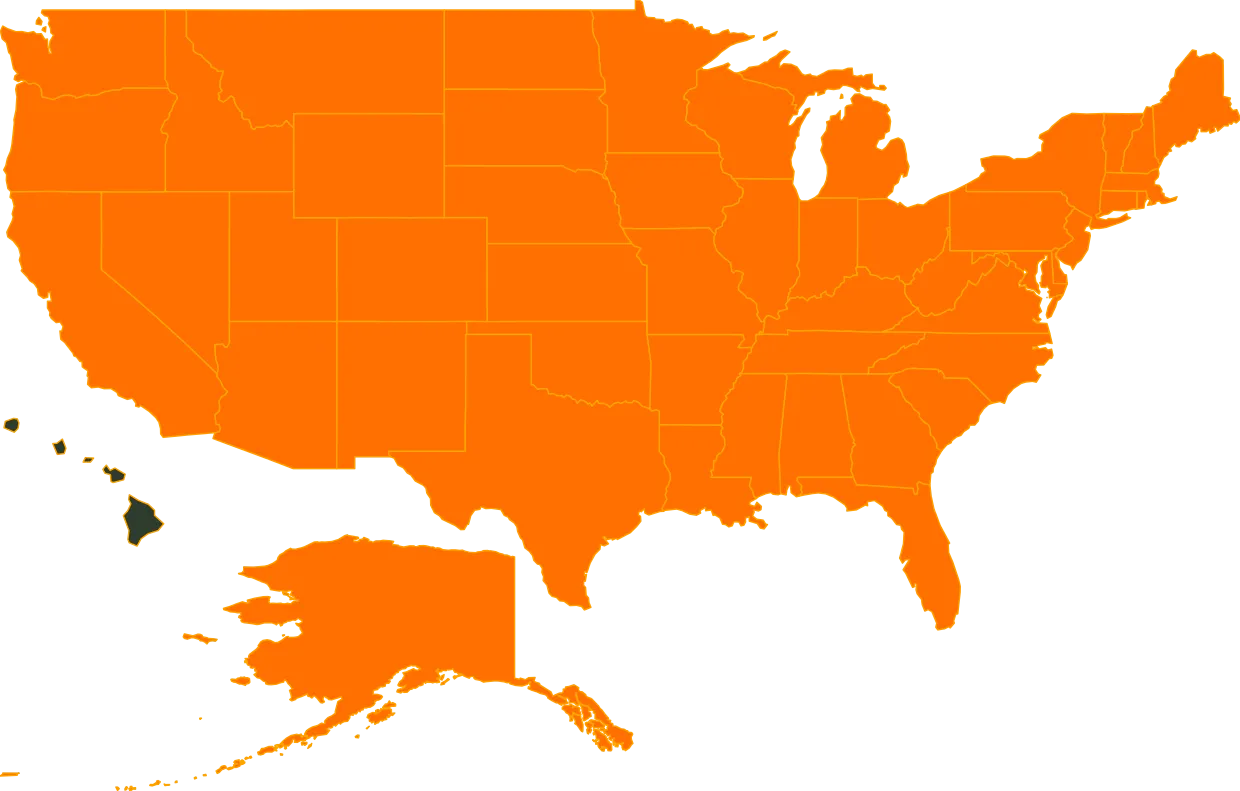
Ring-necked Ducks move mainly through the Mississippi Flyway, with smaller numbers in the Atlantic and Central flyways and a few in California's Central Valley. Minnesota's birds go on to Louisiana, Texas, Florida, Missouri and Arkansas.
Year-Round
Ring-necked Ducks are present year-round in parts of the western Rocky Mountains, though it is unclear whether the winter birds there are the same ones that bred. In most of the continent they leave the breeding range.
Breeding
Ring-necked Ducks nest in boreal and aspen-parkland wetlands from Alaska through Alberta, Saskatchewan, Manitoba, Ontario and Quebec to the Maritimes. In the US they nest in North Dakota, Minnesota, northern Wisconsin and Michigan, the Adirondacks and Maine, with pockets in the western mountains.
Winter
Winter range runs mostly inland, from southern New England and the southern Great Plains south to Mexico. The core is the Gulf coast and southern Atlantic states. Managed impoundments in Louisiana hold the most, most eastern birds winter in Florida, and California's Central Valley is the main Pacific site.
Migration Timing
Ring-necked Ducks are midseason migrants, neither early nor late. They leave breeding areas from mid-September and peak in October in the northern US, November in the central US and late November to early December in the south. Spring departure starts in February or March, with peak numbers in early April.
Ducks Similar to the Ring-necked Duck
Ring-necked Duck vs Scaup
A black back, a white wedge ahead of the folded wing and a white band on a slate bill mark the Ring-necked drake. Scaup drakes have a pale, finely barred gray back and a plain blue bill.
Ring-necked Duck vs Redhead Hen
A white eye-ring and a thin white line running back from the eye mark the Ring-necked hen, on a peaked, angular head. The Redhead hen is rounder-headed and lacks the line.
Ring-necked Duck vs Canvasback
Back color and bill both differ: a Canvasback drake is white-backed with a long all-black bill, a Ring-necked drake black-backed with a white band on a slate bill and a peaked rear crown.
Ring-necked Duck vs Bufflehead
A Bufflehead drake has a white wedge behind the eye and a white breast. The Ring-necked drake's head and chest are black, and its only white wedge sits ahead of the folded wing.
Ring-necked Duck vs Goldeneye
A round or crescent-shaped white face spot marks the goldeneye drake. The Ring-necked drake wears a bold white band on the bill and a black chest.
Habitat
Primary Habitat. Ring-necked Ducks use small, shallow freshwater with emergent and floating plants. Breeding wetlands are marshes, fens and bogs, often acidic, usually under 5 ft deep and fringed with sedges, lilies and shrubs, along with beaver ponds and impoundments. Open water makes up about 5-75 percent of the wetland.
Seasonal Habitat Differences. In migration they use shallow lakes and impoundments with dense cattail, bulrush and wild rice, and small marshes next to open water. In winter the list widens to swamps, river floodplains, fresh and brackish estuary edges, shallow inland lakes, sloughs, flood-control reservoirs, managed impoundments, flooded farmland and aquaculture ponds. They are seldom found where salinity tops 5 ppt or water is deeper than 5 ft.
What to Look For. Shallow water with weed mats, lily pads or flooded vegetation. Small water, including very small ponds, is more likely to hold ringnecks than other divers, while Canvasbacks, Redheads and scaup stay on open water.
Is the Ring-necked Duck Good to Eat?
Ring-necked Ducks are good table birds. Wildfowl magazine rates them excellent to eat and credits a diet of wild rice and other plants. Ducks Unlimited puts plant foods at 80 to 90 percent of what they eat in migration and winter, mostly seeds, tubers and leaves. Outdoor Life still lists the ringneck among the divers to skin before cooking, with the fat trimmed off, because that is where a diver's fishy taste sits.
Frequently Asked Questions
How do you identify a Ring-necked Duck?
The white band near the tip of a slate bill is the mark to look for. The drake has a black head, back and chest with a white wedge ahead of the gray flank. The hen is brown with a white eye-ring and a thin white line behind the eye. Both have a peaked rear crown and no white wing stripe.
How rare is a Ring-necked Duck?
The continental population of Ring-necked Ducks is near 2 million, so they are not rare. USFWS counted about 829,000 breeders in the eastern survey area in 2026, above the 1998-2025 eastern average, and US hunters take roughly 390,000 a year. The Mississippi Flyway holds the most, with Louisiana impoundments and Florida lakes among the main wintering areas.
Are Ring-necked Ducks good to eat?
Yes, they are among the better-eating diving ducks. In fall and winter a ringneck feeds mostly on pondweeds, wild celery, wild rice and other plants, taking their seeds, leaves and tubers, so it lacks the heavy shellfish diet that hurts scaup and scoters at the table. Skinning the breast and trimming the fat is a sound habit with any diver.
How do you tell a Ring-necked Duck from a Scaup?
Check the back first. A Ring-necked drake is black from the back to the chest, with a white wedge at the front of the folded wing, where a scaup drake has a pale gray back with fine barring. The Ring-necked bill carries a white band near the tip, and a scaup's is plain blue. In flight, scaup show a white wing stripe and the Ring-necked shows only a gray speculum.
How do you tell a drake Ring-necked Duck from a hen?
The drake has a black head with a violet sheen, a black back and chest, pale gray flanks and a yellow eye. The hen is brown, darkest on the crown, with a white eye-ring and a thin white line behind the eye. Her slate bill shows only a faint pale band, where the drake's white band is bold.
What does a Ring-necked Duck sound like?
Ring-necked Ducks are quiet, and published descriptions of their voices are thin. Expect short, grating barks and grunts from either sex. The drake gives a soft, weak "wow" during neck stretches and a short whistling cough in group displays. The hen gives high peeps and a short "burrr" growl when alarmed.
Do Ring-necked Ducks actually have a ring around the neck?
Only in theory, because the neck ring is almost never visible in the field. The mark to use is the bill, which carries a bold white band near the black tip on the drake and a faint pale band on the hen. The peaked rear crown helps too.
In the Field
Photo: Sharleen Puckett/USFS
Related Species
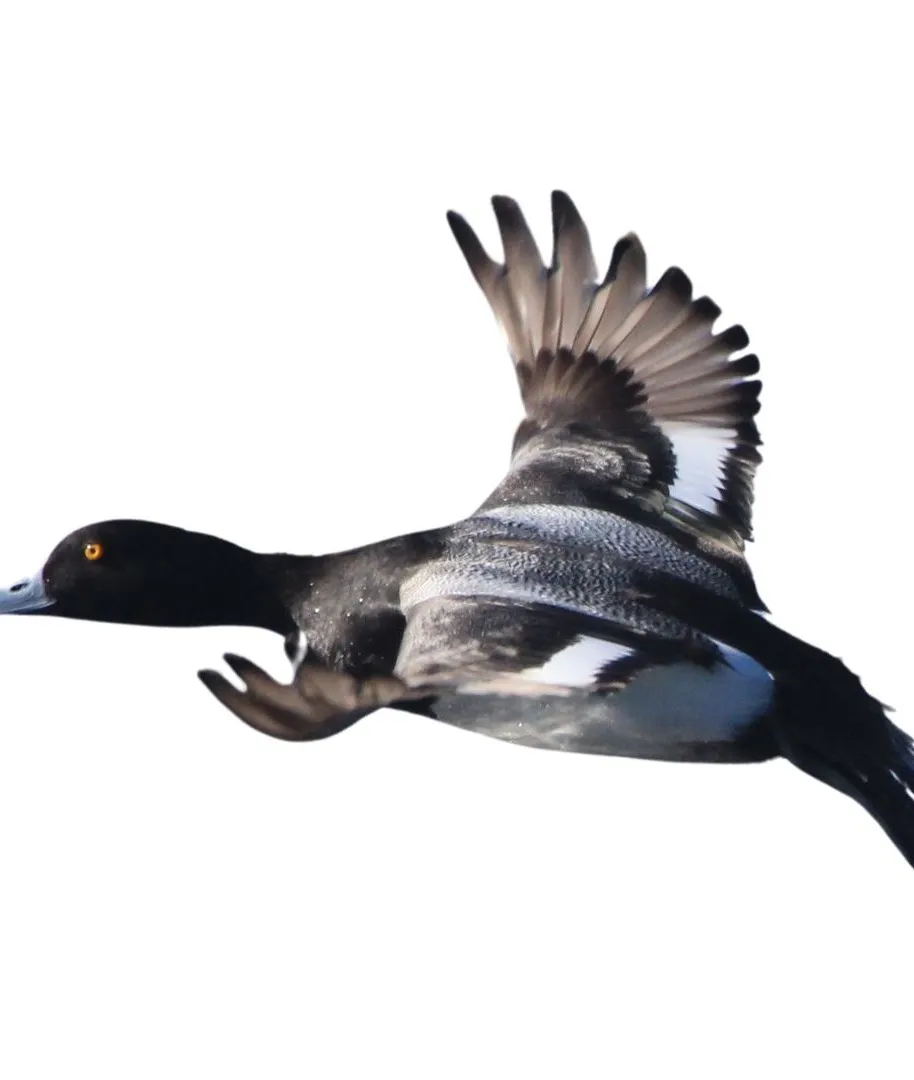 DiverScaupAythya marila, Aythya affinis
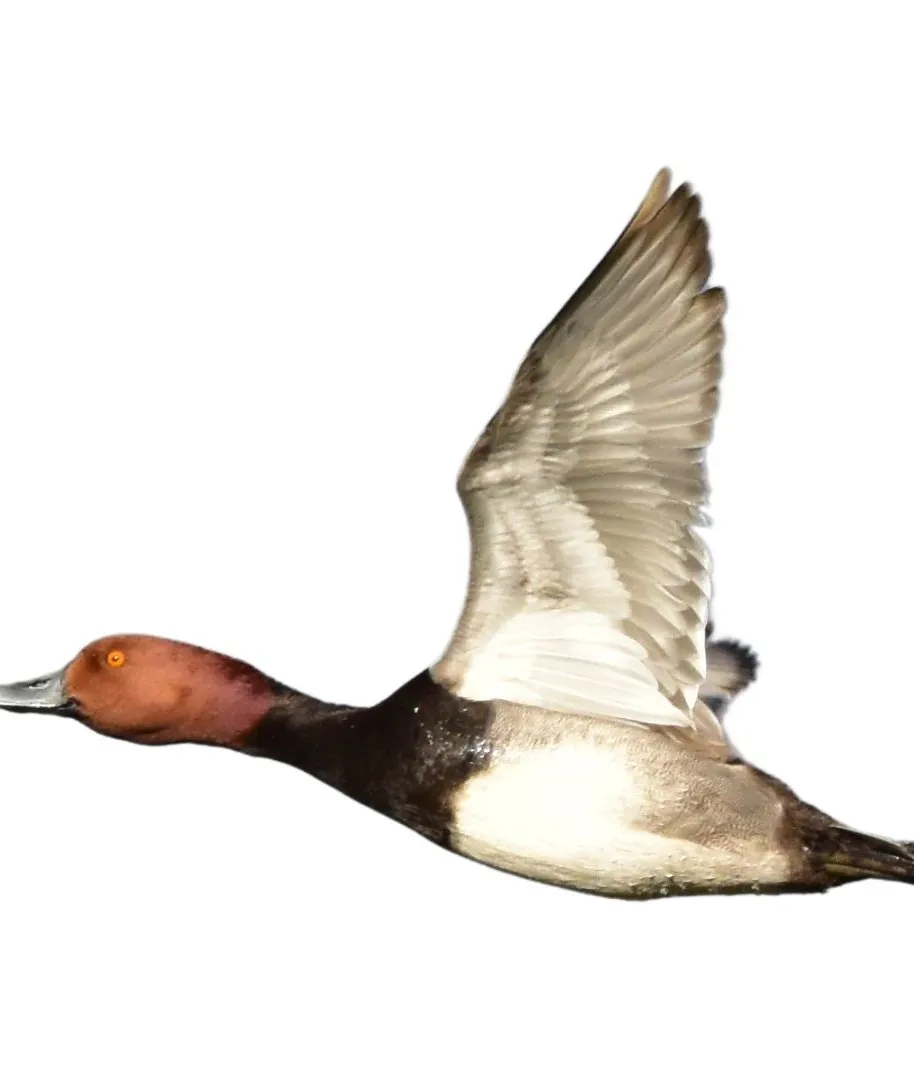 DiverRedheadAythya americana
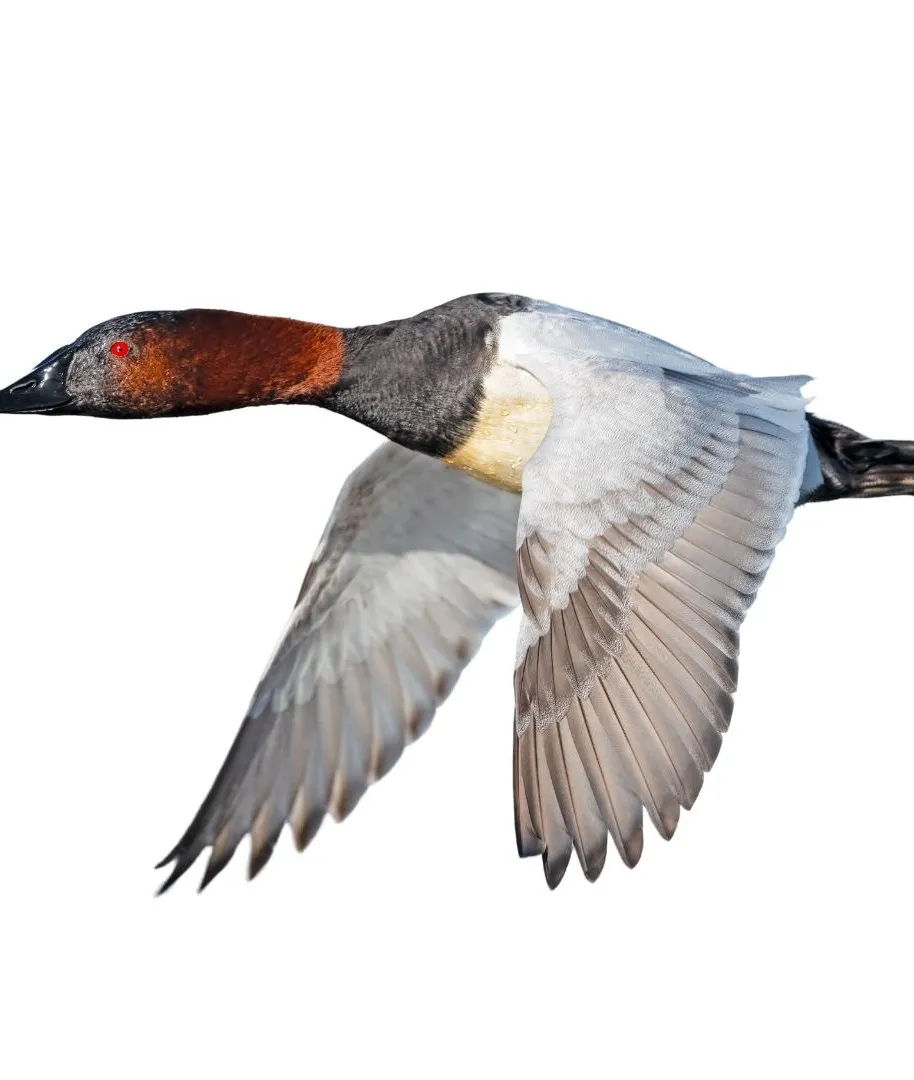 DiverCanvasbackAythya valisineria
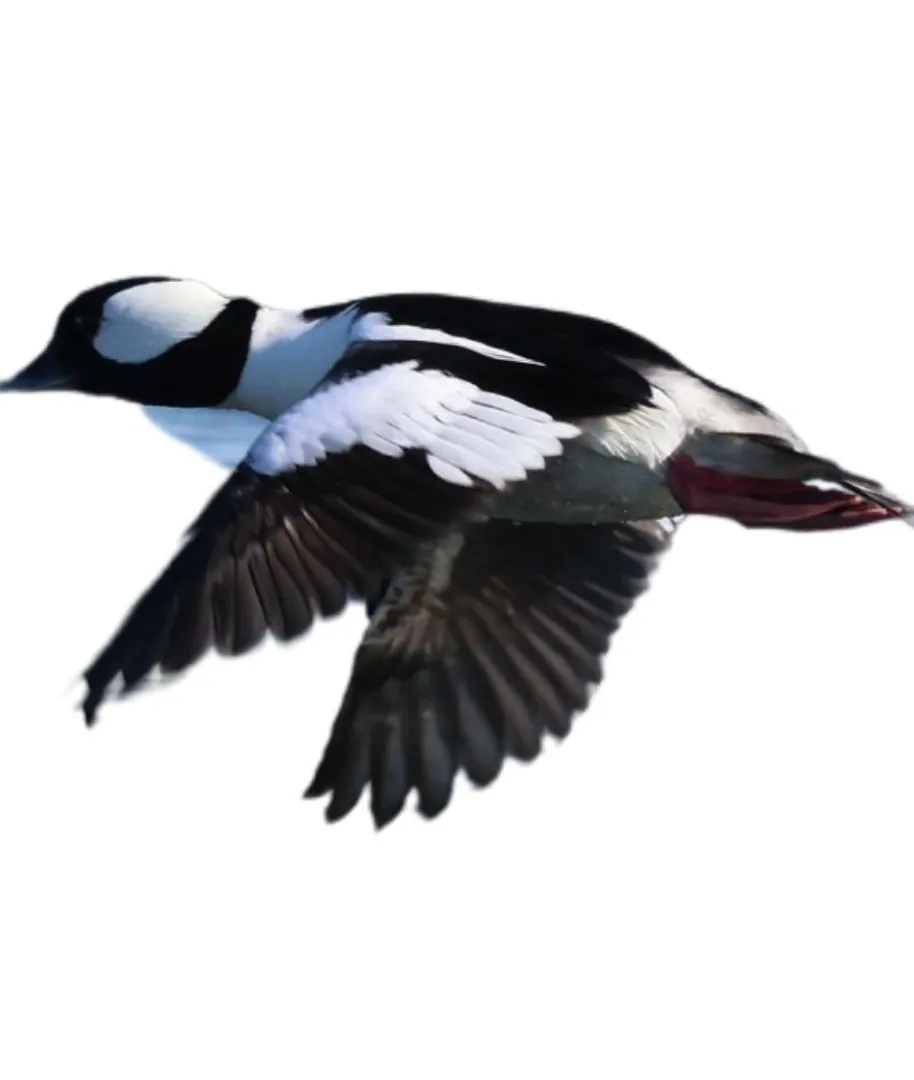 DiverBuffleheadBucephala albeola
- DiverComing SoonGoldeneyeBucephala clangula, Bucephala islandica